Published on: 13 March, 2026 20:25 IST
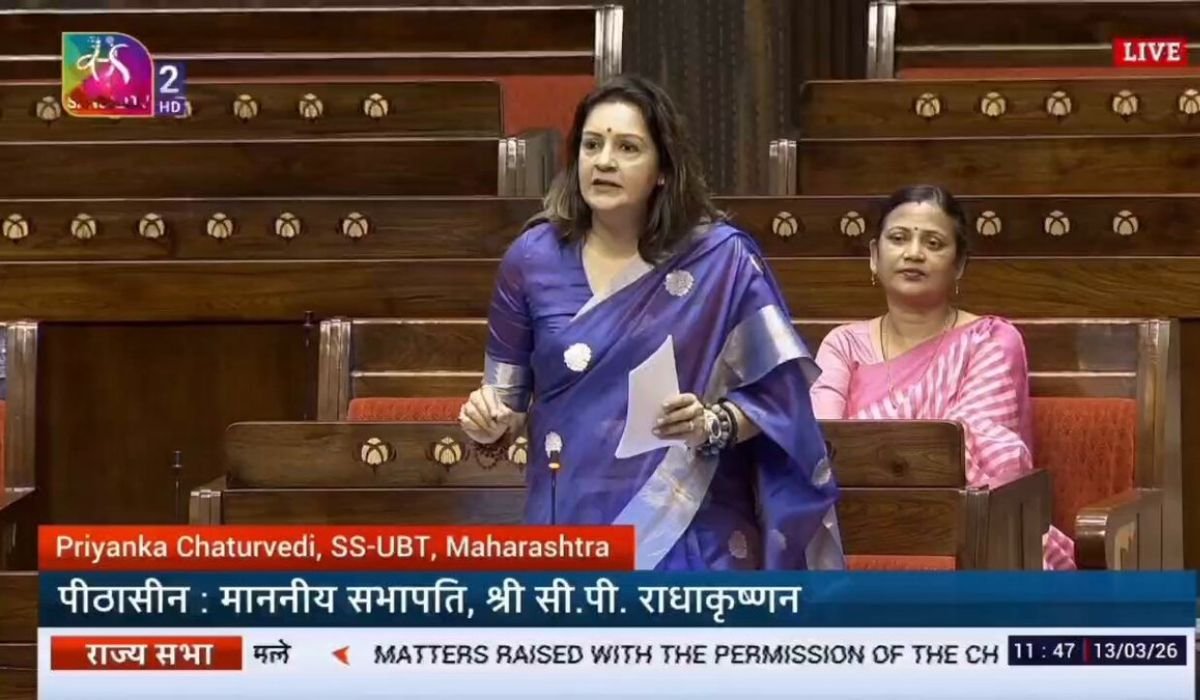
Shiv Sena (Uddhav Balasaheb Thackeray) Rajya Sabha MP Priyanka Chaturvedi on Friday strongly criticised the Supreme Court’s recent orders in the NCERT Class 8 textbook controversy, describing them as amounting to “judicial overreach” and “judicial dictatorship”.
Speaking during Zero Hour in the Rajya Sabha, Chaturvedi urged the government to ensure that all three branches of governance the legislature, executive, and judiciary remain equal before the law and fully open to scrutiny and accountability.
The remarks come in the wake of the Supreme Court’s suo motu proceedings over a Class 8 Social Science textbook chapter titled “The Role of the Judiciary in Our Society,” which referenced “corruption in the judiciary” as one of the institution’s challenges. Last month (February 26, 2026), the apex court imposed a complete blanket ban on the NCERT book’s publication, reprinting, digital dissemination, and distribution, ordering the seizure of physical copies.
On Wednesday (March 11, 2026), a bench led by Chief Justice of India Surya Kant (with Justices Joymalya Bagchi and Vipul M Pancholi) expressed dissatisfaction with NCERT’s “laconic” affidavit, directed the education body to immediately disassociate from the three-member Textbook Development Team Professor Michel Danino (chairperson), Suparna Diwakar, and Alok Prasanna Kumar who drafted the chapter, and barred them for life from any future roles or assignments in government-funded or public institutions/projects.
Chaturvedi acknowledged that the initial ban might have been understandable if the judiciary felt unfairly targeted. “Up to that point, we felt it was fine,” she said. However, she argued that the matter escalated beyond reasonable bounds, with the court pushing for punitive measures against the academics and even indicating potential action against social media users who criticised the order.
She pointed out that NCERT had already tendered an unconditional and unqualified apology and withdrawn the textbook, yet the Supreme Court proceeded with further directions. Chaturvedi highlighted broader concerns about institutional sensitivity to corruption allegations, citing the case of Justice Yashwant Varma (formerly of the Delhi High Court, now transferred to Allahabad High Court).
In March 2025, a fire at Justice Varma’s official residence led to the discovery of burnt currency notes in an outhouse, triggering an inquiry ordered by the then Chief Justice of India. An opposition impeachment motion against him remains pending in the Rajya Sabha.
“Corruption allegations against politicians, police, bureaucracy are routinely investigated… but the judiciary becomes extremely sensitive when there is talk of corruption,” Chaturvedi remarked, adding that an impeachment motion was even brought against a sitting High Court judge in this context.
Her comments echo criticisms from legal experts, educationists, and others who have flagged the orders as overreach, raising questions about academic freedom, freedom of expression, and the balance between protecting judicial dignity and allowing legitimate discourse on institutional challenges.
The controversy continues to fuel debate on transparency, accountability across branches of government, and the limits of judicial intervention in educational content.